Tag: Online

  • Internet Censorship

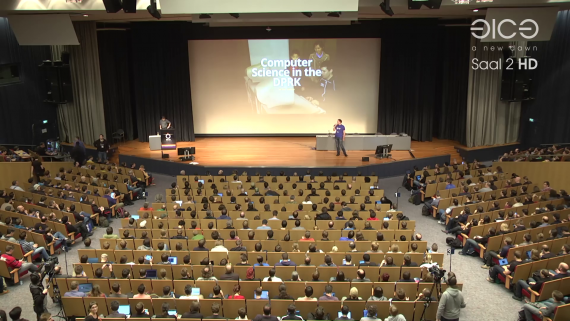
    I had the privilege last week of talking at the 32nd Chaos Communication Congress about the state of Internet Censorship in 2015 and the major developments in blocking and measurements last year.

    The talk is now online and available for streaming. It’s meant as a primer on the topic, and to show the growing normalization and corporate control of filtering.

  • The state of Internet Censorship

    The state of Internet Censorship

    I’ll be presenting next week at 32C3 on the state of Internet access, transparency, and measurement. Lots of the work is done each year on measuring and learning about the state of access, but this phenomenon with growing relevance to many countries is poorly publicized. Much of this is a fear that being too public about what can be measured will make the network operators move to even more opaque techniques, since in many instances these systems are seen to thrive in structures without accountability.

    Needless to say, it has been a busy year in the space, with increased funding for the measurement community and a multitude of new policy in response to ISIS and other perceived threatening uses of Internet Speech.

    I’m excited to be heading back to Germany for the holidays, and hope to provide a reasonable survey of what’s out there and make the network measurement field a bit more accessible!

  • IETF and the HRPC working group

    The Internet Engineering Task Force, the multi-stakeholder organization which shepherds the standards process for many of the technologies used on-line, is continuing to evolve that process. Protocol standards are already expected to include discussions on their security and privacy implications, in order to force an explicit conversation on those issues and hopefully encourage the development of secure systems. Beyond these, a new working group, the Human Rights Protocol Considerations group, was chartered last week. The group exists as part of the process of having another conversation around new protocols as they exist: what are the implications for freedom of expression and freedom of assembly that are wrapped up in our protocol design.

    It seems like a question worth considering, especially as the IETF’s major contribution will be increasingly international. Many protocols emerging today are build by individual companies and are proprietary. We can hope however that it is at the boundaries of these walled ecosystems we create that standard protocols will need to be agreed upon. These boundaries will parallel our cultural discontinuities, and represent important places to have these conversations.

    The group is drafting a methodology document as part of the background for proposing the update to the standards process. It’s an interesting way of thinking about protocols – how do they control or support individual expression? – that I hadn’t thought of before in those terms.
  • Lets Encrypt

    I’ve begun to transition this site to use Lets Encrypt! for signing of SSL. Because the site has specified an HPKP previously, a transition period is needed where clients can see the old certification signing the intention to transition to the new certification.

    That process has started, and the full transition will happen in a couple months. The good news is that the letsencrypt setup process was otherwise painless.

  • Cascadia Fest

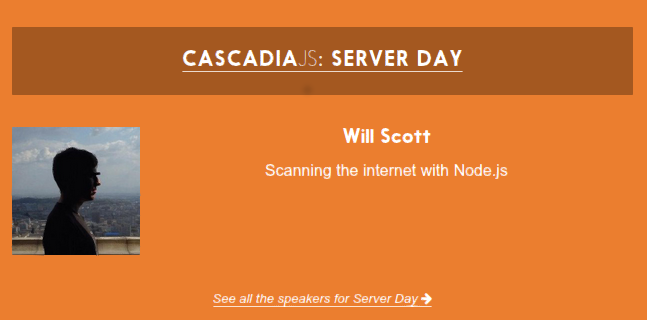
    The video of my talk last month on scanning the Internet using Node.js has been published by Cascadia Fest.

  • CascadiaFest

    cascadiafest

    I’m quite excited to be talking at CascadiaFest this summer about the work I’ve been doing on scanning the Internet.

    My talk proposal is archived here. The cool end-results are still getting ready for publication, but one of the code modules I’m pretty excited about that happened in the process is ip2country.

  • Open Tech Fund

    I’m excited to be supported by the Open Technology Fund on my research of activist.js. I’ve found myself in highly esteemed company, and hope to live up to goals of program.

    Will Scott, a graduate student in the Networking Lab at the University of Washington, will continue his work on Activist.js, a tool that helps publishers resist censorship by maintaining strong websites that are more resilient to network interference.

    Read the OTF announcement.

  • 31C3

    31C3

    I gave a talk last week at CCC in Hamburg on the state of consumer technology in Pyongyang. It’s available for streaming online.

    Images shown in the talk are available.

  • DPRK Intranet

    Technology in the DPRK is in the news cycle
    again. I’m excited to talk a bit more in depth on what technology in Pyongyang looks like next week at CCC.