Most of the conversation around AI-assisted building has focused on software. We have good feedback loops for code. Hardware has a higher barrier: you need to know which parts exist, how to wire them together, and how to get a board made — and mistakes cost real money and weeks of shipping. I recently went through that loop, and updated my prior – that hurdle was lower than I expected.
Artisanal production
For a while now, my computer has connected to my audio system over S/PDIF — optical or RCA coax, in and out. The requirement is simple: a stereo pair each way, with clean clocking. The market doesn’t serve it well. Most of the (relatively few) interfaces with digital I/O are large units that expose 32 or so channels to the computer, which leaves software confused about what should go where.
I’ve used an ESI U24 XL. It mostly works, but occasionally garbles audio, and when plugged into an iPad it pops with some regularity. My guess is that it struggles with timing and buffering between the USB packets arriving from the computer and the PCM stream going out to the speakers.
This is the kind of problem that tends to go unsolved. It’s too niche for a manufacturer to optimize for, but constrained enough that I knew exactly what I wanted. That combination made it a good test of whether I could just build the thing myself.
From prompt to prototype
I started by asking a frontier model — in this case Claude Opus 5.0 — what circuit the conversion would need. It suggested NXP’s i.MX RT1060 family of microcontrollers: plenty of clock speed, with S/PDIF and USB peripherals already on-chip. Before committing to a custom board, I ordered a development kit and had the agent write firmware for an audio round trip. It worked, which was enough to trust the core chip.
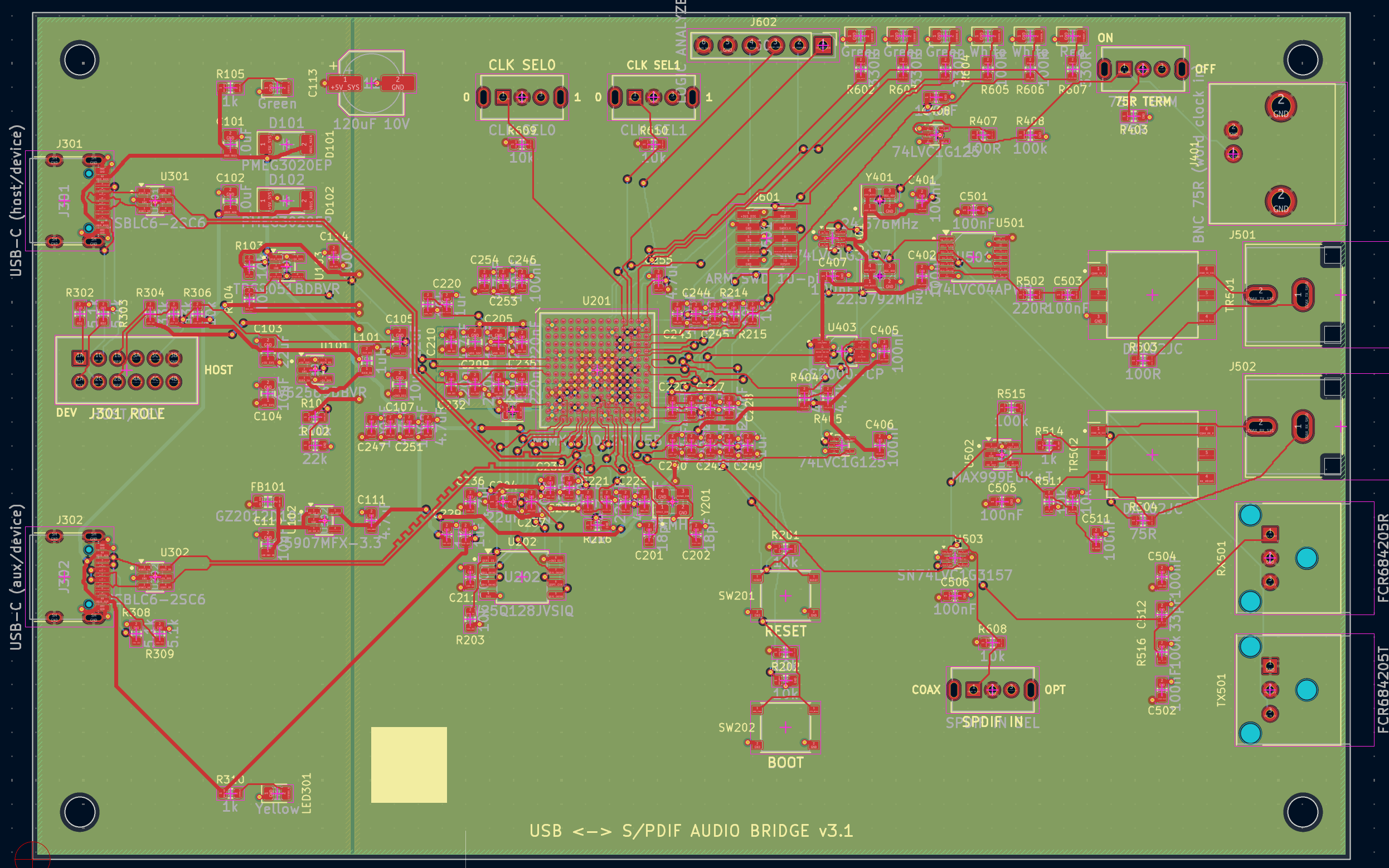
From there I asked for a schematic I could have manufactured. Visual inspection and checking interface behavior only got me so far. The most useful step was working against a complete KiCad project and running the software’s electrical and design rule checks. These catch a range of basic mistakes — unconnected pins, ground shorted to a power net — and provide an objective check on the design, rather than relying on whether it looks plausible.
The remaining iteration was economic. Once I uploaded the design to JLCPCB, component and assembly costs became concrete, and much of the back-and-forth was trading parts against price. A few hours in, I had the design below, which came to about $50 per board for a run of five, fabricated and assembled.
Better than off the shelf
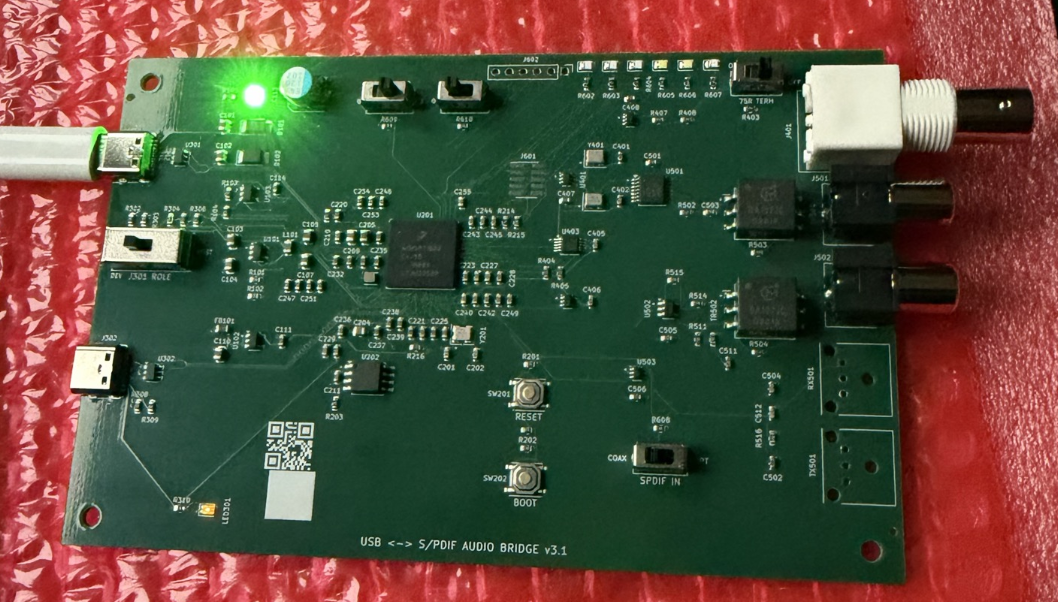
The boards arrived last week. After only a few rounds of flashing, they work better than the U24 XL: music plays without clock drift or popping. They also handle a couple of situations I couldn’t find in any existing product:
- Word clock sync: they can lock to an external word clock as a more precise reference.
- USB host mode: they can do the same conversion for devices that send digital audio over USB but lack S/PDIF ports, like a Yamaha keyboard or a synth.
The long tail
The exciting part isn’t this specific board. It’s that hardware of this complexity is now within reach of a motivated individual. Expertise still helps — knowing what to check and what to ask makes the process far more efficient (you can see plenty of unneeded complexity on the board above – between LEDs, switches, and two USB ports) — but it’s no longer the gate it used to be.
That matters because so many problems live in the long tail: too specific for anyone to build a product around, but worth real money to the person who has them. When a $50 custom circuit can deliver far more than $50 of value, custom hardware becomes a lever that most people have never had. I expect we’ll see a lot more of it.